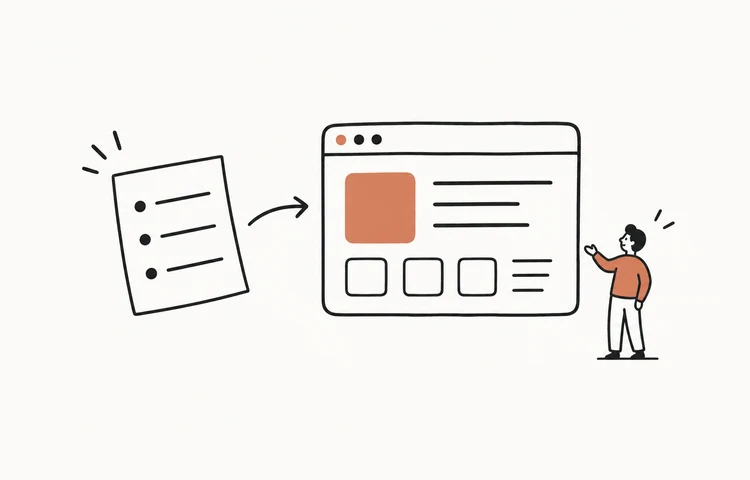
A five-second test briefly shows a design, hides it, and asks people what they understood or remember. Use it for a specific first-impression question, such as whether a page communicates its offer. Keep the viewing conditions and questions explicit, preserve partial or uncertain answers, and test the proposed revision. It does not measure full task success or predict conversion.
Choose one message worth testing
A community repair workshop wants visitors to understand three things immediately: people bring a broken small household item, a volunteer helps them investigate it, and the event does not sell replacement appliances. The current headline is 'Give everyday things another chance.' It sounds appealing, but the team does not know whether a newcomer can tell what the event actually offers.
This is a suitable question for a brief-exposure study. Show the event page, hide it, and ask what the person understood. The result concerns communication under that viewing condition. It will not tell you whether someone can find a suitable session, judge whether their item is eligible, or complete a booking. Those require more time and different tasks.
This worked example follows a repair workshop through a complete test, eight illustrative answers, a proposed revision, and a follow-up plan. The small dataset makes the analysis inspectable; choose your own sample around the decision and uncertainty you need to address.
Write the primary research question as a sentence: 'After a five-second view of the event's first screen, do first-time visitors understand that it offers help repairing an item they bring?' Keep secondary questions limited. Trying to measure service understanding, every eligibility detail, brand recall, emotional appeal, and button location in one short exposure creates an unfocused memory exam.
| Element | What the visitor sees |
|---|---|
| Event name and date | Saturday Together — 7 November 2026 |
| Headline | Give everyday things another chance |
| Supporting text | A community event for a better tomorrow |
| Image | Isolated polished toaster |
| Action | Join us |
Keep the viewing condition explicit
A five-second test usually presents a design briefly and then removes it before asking questions. Lyssna documents this show-and-hide format and provides a configurable duration. The number five describes a study condition, not a universal deadline by which every page must be understood. A dense comparison, a contract, or a safety instruction deserves a method that allows appropriate reading and questions.
For this example, use a screenshot of the first mobile viewport, displayed at a readable mobile size. It contains the event name, headline, supporting sentence, one representative image, and the main action. Do not shrink a long page into the same rectangle and claim to have tested its real first screen. Equally, a desktop image cropped on a phone may remove the very message being tested.
Check loading and presentation with a pilot. Start the exposure after the image is visible, hide it at the specified point, and prevent accidental replay within the recall task. If a technical fault prevents the image from being seen, record it separately. If you intentionally show it again for a later discussion, label that phase as a follow-up with the design visible, not another unprompted first impression.
Decide whether the arrival context is part of the study. A person following a link labelled 'Repair workshop booking' has already received information that someone arriving from a generic event listing has not. Use the same stated context across the compared designs, and include it in the report. This example assumes an unfamiliar visitor arriving from a general community-events listing.
| Field | Study choice |
|---|---|
| Audience | Adults who could attend a local repair event and have not seen this page |
| Arrival context | General community-events listing; no advance explanation of the repair service |
| Material | Mobile first-screen image, version A; readable at the intended viewport |
| Exposure | Five seconds after the image is fully visible |
| Primary question | What do you think this event offers? |
| Secondary question | What would you expect to do if you attended? |
| Later discussion | Only after recall answers are saved; record that the image is visible again |
Ask for an explanation before supplying categories
Use an opening instruction that explains the mechanics without revealing the message: 'You will briefly see an event page. After it disappears, please describe what you understood. We are testing the page, not your memory skills; saying you are unsure is useful.' Do not introduce it as a repair event if recognizing the service is the question you want to study.
Ask the primary open question first: 'What do you think this event offers?' Then ask, 'What would you expect to do if you attended?' These questions help distinguish recognizing a repair service from assuming a shop, a recycling collection, or a lecture. Save the wording exactly; a later analyst should not have to infer which prompt produced an answer.
Avoid 'Did you notice that volunteers help you repair your own item?' It supplies both the intended answer and a reason to agree. A multiple-choice question can be useful for a separately defined recognition measure, but recognizing the correct phrase from a list differs from explaining the offer unaided. Do not combine those two outcomes into one understanding score.
If visual recall is a separate objective, ask it after the primary meaning question: 'What else do you remember?' Keep spontaneous mentions separate from prompted ones. Mentioning a toaster image does not necessarily mean that the person understands the event; a participant may remember the picture while interpreting the service as an appliance sale.
| Question | Useful for | Interpretation to avoid |
|---|---|---|
| What do you think this event offers? | Unaided explanation of the perceived offer | Treating any relevant keyword as full understanding |
| What would you expect to do if you attended? | The activity and the visitor role | Assuming intended attendance or actual booking |
| What else do you remember? | Additional recalled content | Calling every remembered element useful |
| Which of these services was advertised? | Prompted recognition, if separately planned | Combining recognition with unaided recall |
| Would you book? | A stated intention in this setting | Reporting it as a conversion rate |
Create coding rules that preserve partial understanding
Before interpreting the answers, describe what the page needs to communicate. For this exercise, clear understanding means the response identifies assistance repairing an item the visitor brings. A response mentioning repair but leaving the visitor's role unclear is partial. A different offer, such as buying appliances, is a mismatch. An answer that supplies no interpretable offer remains unclear. These categories are defined for this page's objective, not a universal scoring system.
Do not require participants to repeat the headline word for word. 'I take my broken lamp and someone helps me figure it out' expresses the intended meaning even without saying 'volunteer' or 'workshop.' Conversely, remembering 'Give things another chance' repeats the slogan but does not establish what the event does. Meaning matters more than matching the design team's vocabulary.
Retain the original answer beside the assigned category and reason. If two reviewers interpret a response differently, discuss the ambiguity using the declared rules. Revise an unclear rule transparently and apply it consistently to the whole set, rather than changing only the answers that improve the result. Do not turn a qualitative coding exercise into a precise-looking score without an interpretable basis.
The response table below contains all eight illustrative answers. Nothing is omitted because it is awkward to classify. In a real study, keep the original wording securely with appropriate consent and remove identifying details from shared reports. The public report can use carefully selected excerpts alongside complete category counts.
| Response ID and answer | Category | Reason |
|---|---|---|
| P1: I bring a broken lamp and someone helps me try to fix it. | Clear | Visitor brings an item and receives repair help |
| P2: People help you repair a small thing you own. | Clear | Correct service and visitor role |
| P3: A repair place, probably. I am not sure what happens there. | Partial | Repair recognized; participation unclear |
| P4: Maybe a workshop showing repairs. I do not know if I bring anything. | Partial | Repair recognized; visitor role unresolved |
| P5: It looks like a sale of refurbished appliances. | Mismatch | Describes purchasing rather than repair help |
| P6: Somewhere to drop old electronics for recycling. | Mismatch | Describes disposal rather than the offered activity |
| P7: I take my item and work on it with a volunteer. | Clear | Correct activity and visitor role |
| P8: I remember a toaster picture and a date, but not the event. | Unclear | Visual recall without an interpretable offer |
Report the result without turning it into a business forecast
Under these rules, three of eight teaching responses are clear, two partial, two mismatched, and one unclear. The primary descriptive result is 3/8 clear explanations under a five-second mobile exposure. Writing 37.5% is mathematically correct, but the count and small sample should remain prominent. One different answer would change that percentage by 12.5 points.
Do not merge partial and clear responses into 'five understood it' without explaining the changed definition. The visitor's role is central to this event: expecting a demonstration and bringing an item to work on are meaningfully different expectations. The partial responses are valuable because they identify which part of the message remains uncertain.
The two mismatch responses suggest competing interpretations worth addressing. They do not prove that the image caused the misunderstanding or that replacing the headline will eliminate it. We have not isolated the effects of headline, supporting text, image, prior expectations, or viewing duration. Use the pattern to design a next version, then test that version instead of treating the proposed remedy as an observed improvement.
A report saying '62.5% of visitors would leave' would be unsupported. The study did not observe leaving, booking, or a real audience distribution. Likewise, failure to recall a minor detail after five seconds does not establish that readers cannot find it when they need it. Align the conclusion with the actual question and exposure.
| Category | Count | What it means here |
|---|---|---|
| Clear | 3 / 8 | Repair help for an item the visitor brings |
| Partial | 2 / 8 | Repair recognized; visitor activity unclear |
| Mismatch | 2 / 8 | Different service inferred |
| Unclear | 1 / 8 | No interpretable offer |
| Not measured | No result | Booking success, attendance, satisfaction, or real-world abandonment |
Revise the message and the visual emphasis together
The proposed version B makes the service concrete: 'Bring a broken small household item. Learn to repair it with a volunteer.' The supporting sentence says, 'A community repair session, not an appliance shop. Check eligible items and book a time.' This wording is an illustrative proposal; a real organization must verify that it accurately describes its service, eligibility, booking process, and limits.
The revised image would show one visitor and one volunteer examining a small appliance at a workbench, with the item clearly present. An image of shelves full of pristine products might support the shop interpretation instead. The point is to make the pictured activity and the stated offer agree. A more colourful image is not automatically a clearer one.
Preserve important limitations without trying to pack the entire event policy into the first screen. The page should provide a clear route to eligibility and booking details. It must not promise every item will be fixed if the event offers an attempt with volunteer help. Brief-exposure testing of the main message complements, rather than replaces, testing whether people can understand those details when making a decision.
The table records changes as hypotheses. Version B has not been tested in this example. A team can approve a next design direction based on the diagnosed communication problem while still leaving its effectiveness unconfirmed.
| Element | Version A | Version B hypothesis |
|---|---|---|
| Headline | Give everyday things another chance | Name bringing an item and receiving repair help |
| Supporting text | A community event for a better tomorrow | Explain the participation model and link to eligible items |
| Image | Isolated polished toaster | Visitor and volunteer examining an item together |
| Action | Join us | Check items and book a time, if this matches the actual flow |
| Claim boundary | Offer may be interpreted as a shop or drop-off | State repair help without guaranteeing a successful repair |
Retest the first impression, then test the actual decision
For a comparable brief-exposure follow-up, keep the audience criteria, arrival context, viewport, duration, questions, and coding rules aligned. Use people who have not already learned the page's meaning from the first test. Showing the improved design to the original participants may be useful for discussion, but their prior exposure prevents interpreting it as a fresh first impression.
If the goal is to compare versions quantitatively, plan assignment, sample size, analysis, and acceptable uncertainty before collecting the comparison. Do not declare a winner because one small sample produces one more clear answer. If this is an exploratory iteration, describe it as such and use the responses to identify the next unresolved communication problem.
After the first-impression question is addressed, allow realistic reading and interaction. Ask a participant with a specified example item to determine whether it is eligible, find an appropriate session, and explain what they expect the event to provide. That follow-up can expose an eligibility problem even if the headline now communicates the basic offer clearly.
The final handoff should contain a useful next action: test version B's main message with new participants, then inspect the eligibility and booking journey. Save the tested images, exact questions, viewing conditions, raw answers, coding rules, counts, and unresolved questions. A five-second test earns its place by narrowing a design decision, not by providing a general pass mark for the website.
| Prompt | Filled teaching example |
|---|---|
| What must a newcomer understand? | They bring an item and receive help attempting a repair |
| What is shown, and for how long? | Version A first mobile viewport, five seconds |
| What is asked before any answer options? | What do you think this event offers? |
| How will meaning be coded? | Clear, partial, mismatch, unclear using the declared visitor-role rules |
| What did the responses show? | Three clear, two partial, two mismatch, one unclear; all eight invented |
| What changes next? | Make the headline and image describe the same concrete activity |
| What remains untested? | Version B, eligibility understanding, booking, attendance, accessibility |
| What evidence comes next? | Fresh brief-exposure responses and a complete eligibility/booking task |