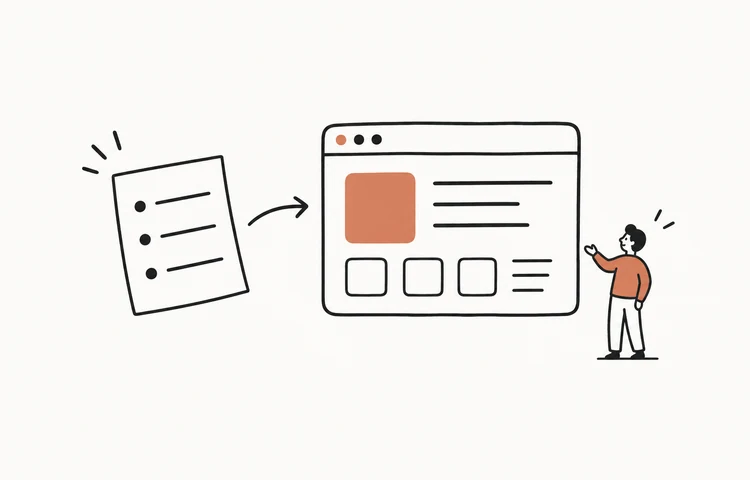
To build an app prototype with AI, define one validation goal, scope one core workflow, generate a working version, test it with representative users, and treat production as a separate decision. AI removes much of the implementation delay, but it does not decide what evidence matters. A prototype succeeds when it helps the team make a better product decision, not when it contains the most features.
This tutorial owns the prototype-specific workflow. If you need a broader overview of the available platforms, use the AI app builder comparison dataset. If the idea itself is already chosen, the MVP Scope Generator turns it into a bounded first build before any AI starts writing code.
Ready to shape the interface? Follow our Codex frontend design workflow to compare visual directions with Product Design or implement an existing Figma design, then check the real interactions.
1. Start with a validation goal
A validation goal states what the team needs to learn. “Build a weather app” is an output. “Can a commuter understand the next six hours and the week ahead from one dark dashboard?” is a testable product question. The second version tells you what to build, what to omit, and what to watch during user testing.
Write the goal in three lines:
- Assumption: what must be true for the product idea to matter?
- Task: what should a representative user complete in the prototype?
- Signal: what observable behavior would support or weaken the assumption?
Avoid vanity signals such as “the team likes it.” Prefer task completion, time to understand, repeated use, willingness to share data, or a concrete follow-up action.
2. Scope one core workflow
The first prototype needs one primary user and one complete path to value. A weather dashboard might open with the current conditions, let the user scan the hourly outlook, and end with a confident decision about the day. Authentication, saved places, alerts, social sharing, and advanced maps may all be reasonable later; none proves that the core information hierarchy works.
Separate the scope into Must, Should, Later, and explicitly out of scope. “Out of scope” is not a graveyard. It protects the test from becoming ambiguous. If the prototype fails, you should know whether the assumption failed—not wonder whether feature seventeen was missing.
3. Choose the right prototype fidelity
Prototype fidelity means how realistic the interface, content, data, and behavior need to be for the decision. Higher fidelity is not automatically better.
- Flow fidelity: can the user complete the important sequence?
- Content fidelity: are labels and examples realistic enough to understand?
- Visual fidelity: does design quality affect the assumption being tested?
- Data fidelity: is representative sample data enough, or must a real source be connected?
- Technical fidelity: which behavior must truly work instead of being simulated?
A design-direction test needs believable typography, spacing, color, and hierarchy. A checkout-risk test needs real error states and provider constraints. Do not spend two hours wiring production infrastructure for a test that only asks whether users understand the screen order.
4. Build and review in short loops
Give the AI the user, job, workflow, exclusions, acceptance criteria, and design direction. Then review the running result instead of expanding the initial brief forever. Correct one layer at a time: product flow first, information hierarchy second, interaction states third, visual polish last.
- Generate the smallest version that reaches the intended outcome.
- Try the task yourself without explaining the interface.
- Fix the first broken or confusing step.
- Repeat until the acceptance criteria pass.
- Stop before Later features turn the test into a roadmap demo.
This is where conversational building helps a team: product, design, and engineering can react to the same live preview and see each correction applied. The advantage is the shared review loop, not a promise that every spoken idea belongs in the product.
A real example: Skycast
Skycast began with a bounded brief for a sleek weather app: dark cyberpunk styling, neon-on-near-black visuals, and a sci-fi console feel. The public curated example shows a working weather dashboard produced in about nine minutes across six build rounds. The result includes current conditions, an hourly strip, and a seven-day forecast—the core information needed to test the dashboard concept.
The lesson is not that every prototype should take nine minutes. It is that a concrete user outcome and visual direction created a reviewable artifact quickly. Saved locations, notification infrastructure, account systems, and operational weather-data guarantees would belong to a different production decision.
5. Run user testing without coaching
Give each participant a realistic task and ask them to think aloud. Do not teach them where to click. Record whether they complete the task, where they hesitate, what they misread, and which information they expect but cannot find. Three focused sessions often reveal more than a large internal review because the team already knows how the product is supposed to work.
Separate usability problems from product-assumption problems. A hidden button is a usability issue. A user completing the flow but not caring about the outcome challenges the product assumption. AI can revise the first quickly; it cannot turn weak demand into strong demand.
6. Define the production boundary
A working preview is evidence, not a production certificate. The production boundary begins where real users, real data, money, or operational promises enter the system. Before crossing it, review authentication and authorization, privacy, data durability, backups, payment failure paths, monitoring, accessibility, performance, abuse controls, and ownership of deployment and support.
The source code and prototype still save time: the validated workflow, language, information hierarchy, and interaction decisions can move into the production build. For a deeper reliability boundary, read making an AI coding agent reliable in production.
The prototype decision checklist
- Can the team state the validation goal in one sentence?
- Is there one primary user and one core workflow?
- Does the prototype use only the fidelity required for the test?
- Are Later and out-of-scope items written down?
- Can a representative user complete the task without coaching?
- Did the test produce evidence strong enough to stop, revise, or invest?
- Is the production boundary explicit before real data or money enters the app?
Frequently asked questions
Can AI build a working app prototype?
Yes. An AI app builder can turn a focused product brief into a running web app with real screens and interactions. The prototype is useful when it tests one product assumption; it is not automatically production-ready just because the preview works.
What should an app prototype include?
Include one primary user, one important job, one complete workflow, realistic states, a success signal, and enough visual fidelity for the intended test. Defer secondary roles, broad integrations, advanced analytics, and speculative features.
How long does an AI app prototype take?
A focused first version can take minutes to hours. The real schedule depends less on code generation than on how quickly the team agrees on the validation goal, scope, and review criteria. A larger prototype with multiple workflows still needs deliberate iteration and testing.
Is an AI prototype ready for production?
Not by default. Production adds authentication, authorization, data durability, privacy, security review, observability, performance, accessibility, failure handling, and operating ownership. Treat the prototype as evidence and a starting codebase, then cross that boundary explicitly.