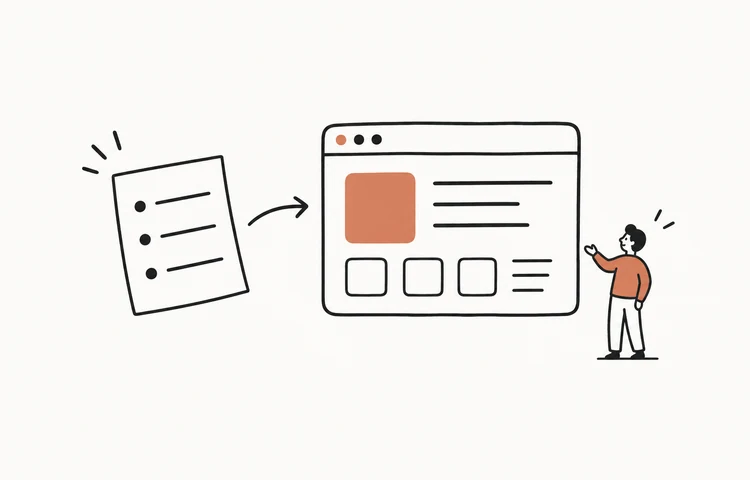
Good requirements-gathering questions start with the user's current work and the decision the product must improve. Ask who performs the task, what triggers it, what information enters and leaves, where delays or errors occur, which exceptions matter, who owns approval, and what evidence would show improvement. Keep solution ideas as hypotheses until the underlying need and constraints are clear.
What requirements gathering questions should uncover
Good requirements-gathering questions start with the user's current work and the decision the product must improve. Ask who performs the task, what triggers it, what information enters and leaves, where delays or errors occur, which exceptions matter, who owns approval, and what evidence would show improvement. Keep solution ideas as hypotheses until the underlying need and constraints are clear.
Copyable product interview guide
Use these groups as a facilitator guide rather than a questionnaire that must be read word for word. Select the prompts that help reconstruct one real workflow and decision.
Before the interview, choose one workflow and mark which questions are essential. During the conversation, capture examples in the participant's language and label assumptions visibly. Afterward, group notes by workflow stage and evidence status rather than by the order questions were asked. Send the playback to the participant or responsible stakeholder for correction before translating it into product artifacts.
- Role, recent task, trigger, desired outcome, and decision owner
- Inputs, outputs, tools, handoffs, waiting, workarounds, and evidence
- Normal path, edge cases, failure recovery, permissions, privacy, and policy constraints
- Frequency, consequence, success signal, competing interpretations, and follow-up owner
- Confirmed fact, participant interpretation, product hypothesis, unresolved question, and correction status
A shared-review product example
For a shared-review product, do not begin with Which dashboard widgets do you want? Ask how a reviewer receives work today, what makes an item ready, how conflicting feedback is resolved, which information must remain private, what happens when the owner is absent, and what evidence would make a new workflow worth adopting.
- Start from a recent real task
- Probe one failure or exception at a time
- Repeat the answer back without adding a solution
- Close with evidence and unresolved questions
Reconstruct the current workflow before discussing features
Organize the conversation by evidence, not by a generic list of features. Ask the participant to walk through the last time the work happened, including the trigger, people, inputs, handoffs, tools, waiting, exceptions, and final decision. Follow vague words such as difficult, fast, or approved with a request for a concrete example. The result should identify what is observed, what is the participant's interpretation, and what still requires another person's perspective.
Run a contradiction pass after playback. Compare what different roles say about the same trigger, approval, source of truth, exception, and success measure. Do not merge disagreements into a false consensus. Record who can resolve each question, what evidence would help, and whether the first preview should test the uncertain assumption or avoid depending on it.
- Atlassian: requirements gathering guide
- Atlassian: product requirements template
Probe exceptions, constraints, and evidence
Use different question types deliberately. Descriptive questions reconstruct the workflow; contrast questions reveal how easy and difficult cases differ; consequence questions expose cost or risk; constraint questions cover access, policy, data, timing, and dependencies; evidence questions define how an improvement could be judged. Avoid asking whether the participant likes a proposed screen before the underlying task and decision are understood.
Turn the interview into a corrected playback
After the interview, return a short playback rather than a polished requirements document. List confirmed workflow facts, representative examples, competing interpretations, proposed product hypotheses, and unanswered questions with owners. The participant should be able to correct the playback. Only then should the team decide which need is ready to become a user story, requirement, acceptance scenario, or prototype experiment.
What an interview cannot prove
A preview is not evidence of production security, compliance, or launch readiness.
- Questions refer to a real role and workflow
- Current facts are separated from proposed solutions
- Exceptions and constraints are probed
- Unknowns remain explicit follow-ups