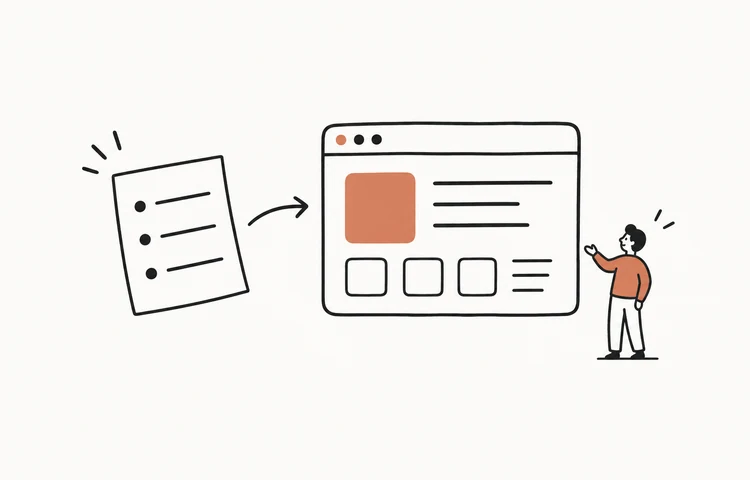
As a nontechnical founder, write acceptance criteria as plain-language checks that describe what the app must do, what counts as done, and what should not happen. In SayCraft, that helps you iterate on a working preview with clearer feedback, but the criteria still need human review because they are a product definition tool, not a guarantee of production readiness.
Community signal: In community posts about nontechnical builders and best practices for vibe coding, people often describe acceptance criteria as the missing bridge between a good idea and a usable preview. That is anecdotal discussion, but it reflects a common pain point: vague requests lead to vague outputs, while simple checks make iteration easier.
What acceptance criteria are for a founder
Acceptance criteria are not a technical spec. They are a plain-language list of conditions that tell you whether the first version matches what you asked for. For a nontechnical founder, they are useful because they reduce back-and-forth and make the preview easier to evaluate.
In SayCraft, acceptance criteria are especially helpful because the app is built from a product conversation. If you can describe the success conditions clearly, the preview can reflect them more accurately and you can iterate with less guessing.
- Describe the behavior you expect.
- Use observable outcomes, not vague preferences.
- Keep the list tied to one workflow.
Write them from the user's point of view
A strong acceptance criterion usually starts with the user action and ends with the expected result. For example, a founder might say that a user can create an account, reach the dashboard, and see a confirmation that the setup is complete. That is easier to test than saying the flow should feel smooth.
Try to avoid language like elegant, modern, or intuitive unless you are pairing it with a concrete check. Those words can be useful for design direction, but they do not tell you what to verify in a preview.
- User can complete step one without help.
- User sees a clear confirmation after submission.
- User can recover from an error without losing progress.
Use pass, fail, and not in scope language
Founders often write acceptance criteria as wishes. A better approach is to use pass, fail, and not in scope language. Pass means the app does the thing you asked for. Fail means it does not. Not in scope means the request should not expand into something else during the first iteration.
This keeps the conversation bounded. It also helps you avoid accidental feature creep when the preview opens new possibilities you did not intend to commit to yet.
- Pass: the user can complete the intended action.
- Fail: the app blocks the action without a clear reason.
- Not in scope: secondary features that do not support the first workflow.
Keep criteria specific enough to review
If you are too broad, you cannot tell whether the preview is good. If you are too detailed, you may turn acceptance criteria into a technical checklist that is hard to maintain. The best middle ground is specific enough to observe, but simple enough to read aloud.
For example, instead of writing that the app should manage users well, write that the founder can invite one teammate, the teammate can accept the invitation, and both can see the same project state. That gives you a concrete review path without assuming the app is ready for production security or compliance.
- One criterion per behavior.
- One workflow at a time.
- One reviewer language style across the brief.
Map criteria to the prototype review cycle
Once you have criteria, use them as the feedback list for each preview iteration. If a preview fails a criterion, note whether the issue is a scope problem, a missing clarification, or a design mismatch. That keeps the conversation productive and focused on the right kind of revision.
SayCraft can help you move from conversation to preview, but the criteria tell you what to inspect. They are the boundary between idea exploration and product evaluation, which is why they matter so much for nontechnical founders.
- Review each criterion after every preview update.
- Separate product ambiguity from execution issues.
- Use the list to decide what to refine next.
A starter template you can reuse
A simple template helps founders move faster without losing clarity: when the user does X, the app should do Y, and the result should be Z. Add one line for what should not happen and one line for open questions. That is enough to begin a useful review.
If needed, involve a human reviewer for anything involving payments, access, accessibility, or handoff. Acceptance criteria can help organize those concerns, but they do not replace manual judgment or later technical review.
- When the user does X, the app should do Y.
- The result should be Z.
- It should not do A.
- Open question: B needs human review.
Sources and discussion
- Reddit: nontechnical builders using AI (community)
- Reddit: best practices for vibe coding (community)
Community posts describe individual experiences and questions; they are not treated as universal proof.
Related resources
Build the next step with SayCraft
Write three to seven acceptance checks for the first workflow, keep them observable, and review them with a human before you expand scope. SayCraft can help you shape the preview around those checks.