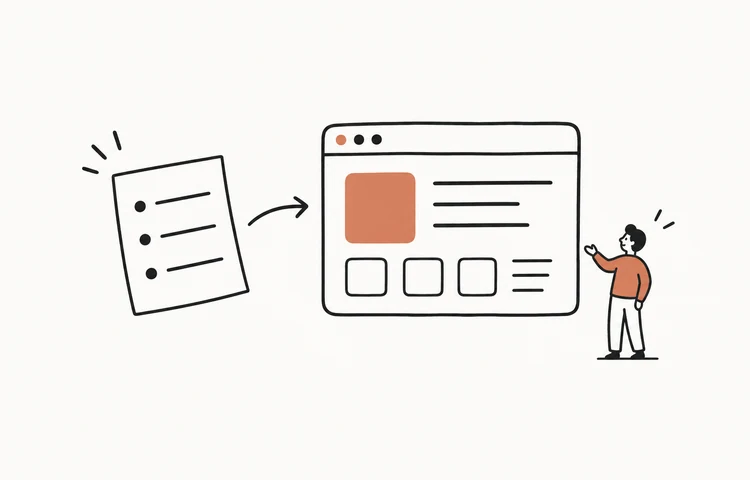
You can create a product landing page for free with AI by giving it a focused product brief, reviewing the working page, and refining the message in plain language. For a SaaS or app launch, the useful output is not a pretty mockup: it is a responsive page with a clear promise, believable proof, and one action a visitor can take. This is not an ecommerce product-detail page; it is the page that explains and launches a software product.
SayCraft publishes this guide and builds this kind of page. Our distinctive workflow is conversational: a founder, product manager, and designer can discuss positioning together while the page appears on a live preview. The method below still works in a typed AI builder; the difference is that SayCraft lets the product discussion itself become the build input.
What a product landing page needs to do
A product landing page has one job: move one specific visitor toward one honest next step. It is not a compressed corporate website, and it should not contain every idea from the roadmap.
- Hero: name the audience, problem, and outcome before describing technology.
- Problem: show that you understand the current painful workflow.
- Outcome: explain what becomes faster, easier, safer, or newly possible.
- Capabilities: connect three to five product features to user outcomes.
- Proof: use a real screenshot, demo, result, quote, or transparent founder evidence.
- Offer: state the free tier, price, waitlist status, or availability honestly.
- FAQ: answer the objections that block the next step.
- Primary CTA: repeat one action instead of competing buttons.
If the product is not ready, use a waitlist, early-access request, or demo CTA. A fake purchase button creates a stronger-looking page and weaker trust.
Copy this product landing page brief
Before choosing colors or sections, prepare these seven decisions. You can paste this into an AI builder or read it aloud in a SayCraft meeting:
Product: [name and category]
Audience: [one specific user]
Pain: [the current frustrating workflow]
Promise: [the concrete outcome]
Proof: [demo, screenshot, result, quote, or honest founder evidence]
Visual direction: [three adjectives plus any brand colors]
Sections: hero, problem, outcome, capabilities, proof, offer, FAQ
Primary action: [join waitlist / start free / request access / book demo]
Weak briefs ask for a modern landing page. Strong briefs explain who the page must persuade, what they struggle with, why this product is different, and what they should do next.
How to build the landing page with AI for free
- Choose one conversion goal. Do not mix a waitlist, checkout, newsletter, demo, and contact form on the first version.
- Open the build session. Start from the AI website builder or review the meeting-to-product workflow.
- Give the product brief. Speak naturally. Include the audience, pain, promise, proof, visual direction, sections, and CTA.
- Then watch the live preview. Review a working page rather than debating an abstract document.
- Correct one layer at a time. Fix the promise first, then section order, proof, visual hierarchy, and small copy.
- Verify before sharing. Check every claim, link, button destination, mobile section, and image.
A concrete example: a launch page for a feedback tool
Imagine a founder launching a tool that turns customer interviews into prioritized product insights. The team might say: “The audience is early-stage SaaS product managers. Their pain is manually rereading calls and losing important patterns. The promise is a ranked evidence board after every interview batch. Use a calm editorial style, show the evidence board, and make ‘Join the private beta’ the only CTA.”
The first generated page should contain a hero about the ranked evidence board, a short before-and-after workflow, three capabilities tied to decisions, one truthful product screenshot, the beta offer, and objections about privacy and integrations. If the hero instead says “Revolutionize your workflow with AI,” the next instruction should fix the message before anyone adjusts gradients.
What free does and does not mean
Generating a working page is only one part of launching. Check these capabilities separately before choosing any free tool:
- Generation: can you create and revise the actual page without paying?
- Preview and sharing: do you receive a URL another person can open?
- Ownership: can you export the source code and continue elsewhere?
- Custom domain: is connecting your own domain included or paid?
- Lead capture: where do form submissions go, and is storage included?
- Payments and analytics: are they built in, integrated separately, or absent?
SayCraft offers a three-day Pro trial with 2,000 credits and a required payment method, then $4.90/month unless canceled. It includes live preview and replay access. A permanent deployed link is a Pro capability, while downloading the generated source is a Max capability. Treat custom domains, lead storage, payments, analytics, and other marketing infrastructure as separate checks rather than assuming that a free AI landing page generator includes them.
Product landing page checklist
- The first screen names a specific audience and outcome.
- The page has one primary CTA with a working destination.
- Features explain benefits rather than listing technology.
- Every proof claim is real and labelled accurately.
- The page remains readable and persuasive on a phone.
- Images load quickly and show the actual product where possible.
- The offer matches the product's real availability.
- Someone outside the team can explain the product after one read.
Build the page from the conversation you already need
Creating the page is not mainly a design problem. The hard part is deciding who the product is for, what it changes, what evidence supports it, and what visitors should do next. SayCraft lets the team make those decisions in conversation and immediately inspect the working result. For more examples of suitable pages, see website ideas you can build and how to build a website by talking.
Build your product landing page free
Frequently asked questions
Can I create a product landing page for free?
Yes. A free AI website builder can generate the first working version from a product brief, including the layout, copy, visual direction, and calls to action. Free publishing, custom domains, lead storage, payments, and analytics vary by platform, so treat those as separate checks rather than assuming every free builder includes them.
Can AI write the landing page copy?
AI can draft the hero, problem statement, benefits, feature explanations, FAQ, and calls to action. The founder still needs to supply the real audience, problem, promise, and proof. AI is strongest at turning those decisions into a coherent page, not inventing evidence that does not exist.
What should I prepare before building the page?
Prepare one target audience, one painful problem, one promised outcome, three supporting capabilities, any real proof you have, the visual tone, and one primary action such as joining a waitlist or starting a trial. That is enough for a useful first draft.
Do I need coding or design skills?
No. With SayCraft, you describe the product and react to the live page in ordinary conversation. The AI handles the initial code, layout, and visual system. You still make product and messaging decisions, but you do not need to write HTML, CSS, or JavaScript.
Is a landing page enough before the product is built?
It can be. A clear page with an honest waitlist or contact action lets you test whether the message attracts the right people before investing in a full product. Do not imply that unavailable features already exist; label the product as a concept, prototype, private beta, or upcoming launch.